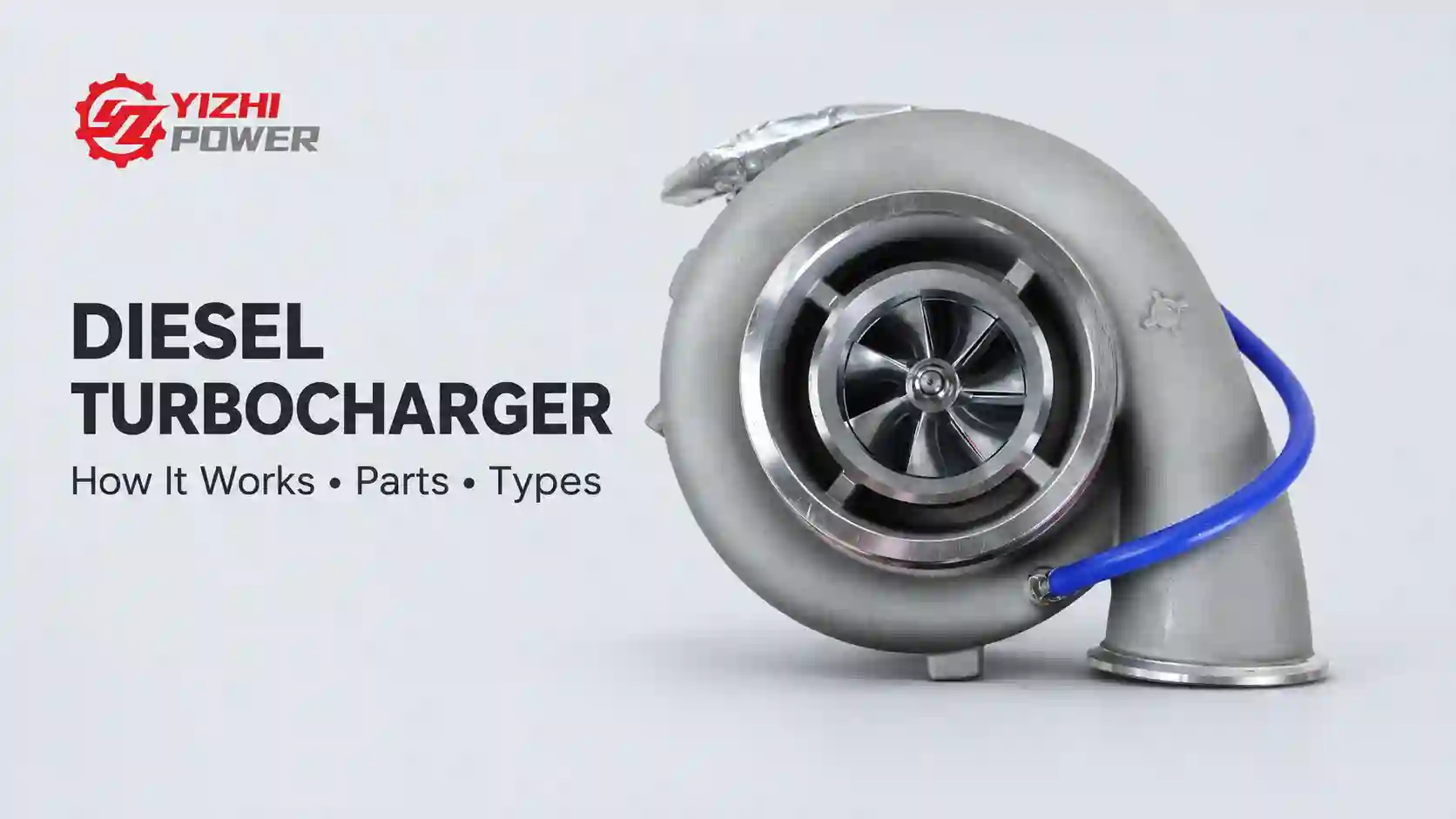
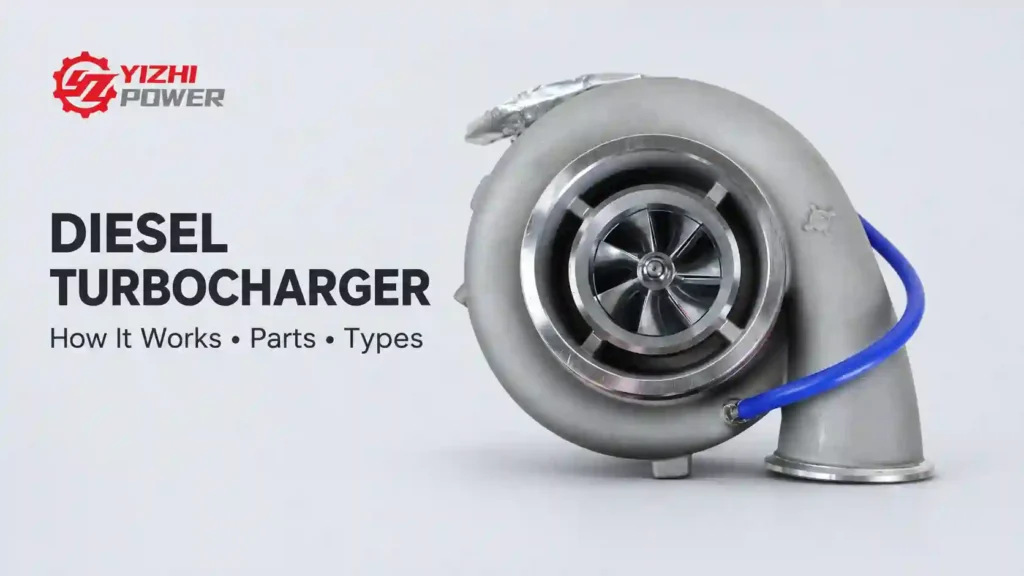
A diesel turbocharger uses exhaust energy to drive a compressor that pushes more air into the engine. With more air available, the engine can burn more fuel and produce more power from the same displacement. The exhaust gas and fresh intake air travel through separate sides of the turbo.
The basic idea is straightforward. The differences between individual turbos take more explaining. A unit built for steady generator duty may use a different control system from one fitted to a truck with changing loads. Understanding those differences helps when comparing turbocharger assemblies, center cartridges, and actuators.
How Does a Diesel Turbocharger Work?
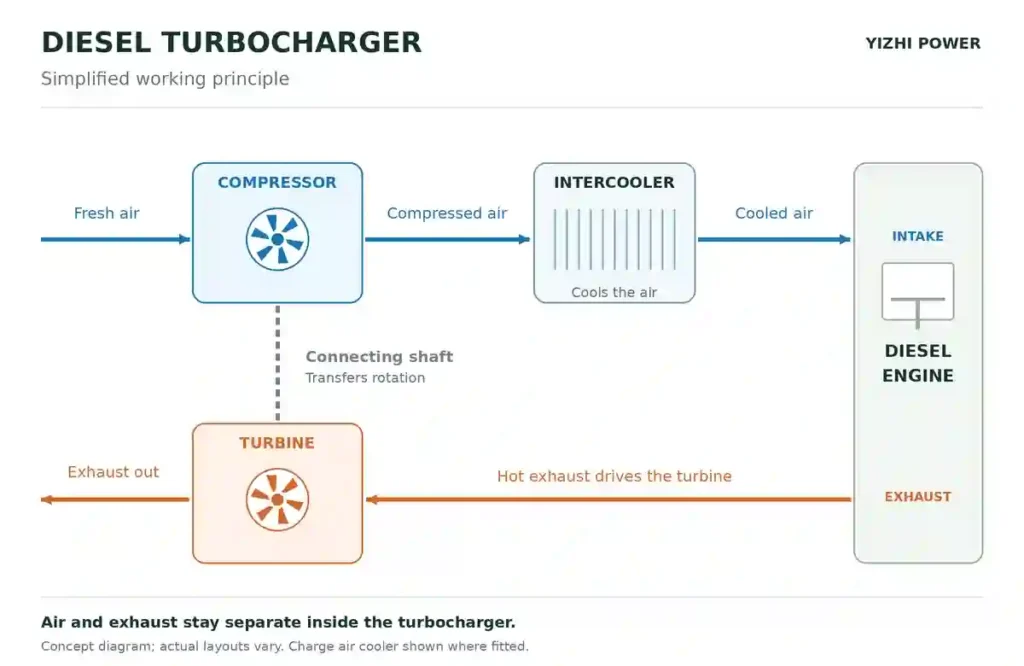
A conventional exhaust-driven turbo has two wheels joined by a shaft. One sits in the exhaust path; the other sits in the fresh-air path. Here is the sequence:
1. Exhaust enters the turbine housing. Gas leaving the engine turns the turbine wheel.
2. The shaft transfers that rotation. The turbine drives the compressor wheel on the other end.
3. The compressor draws in and pressurizes fresh air. This increases the air supplied to the engine.
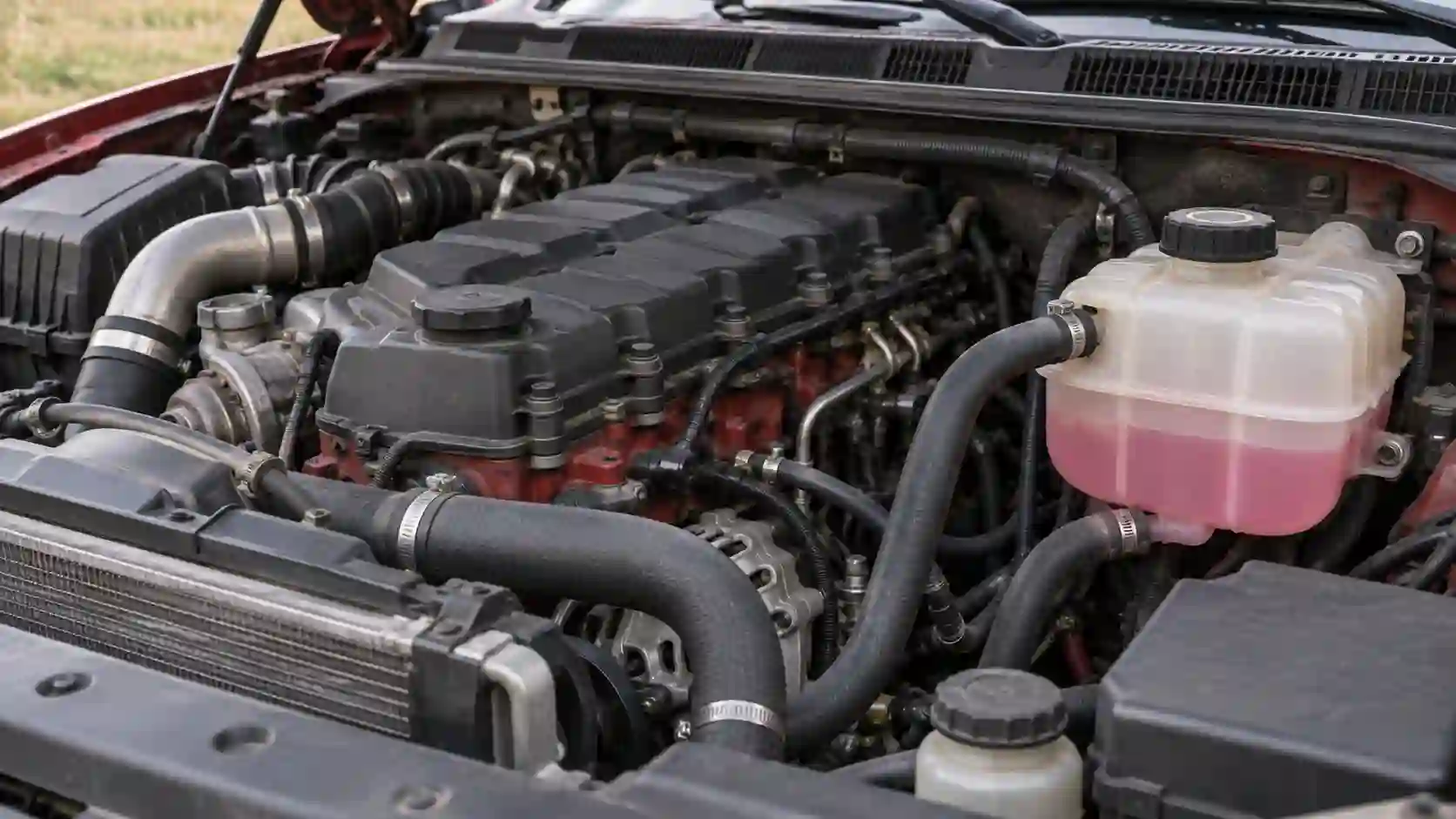
4. The air moves toward the cylinders. On engines with a charge air cooler, it passes through the cooler first.
The turbo handles the air supply. Fuel delivery remains the job of the injection system, working with the engine’s controls.
Why Is an Intercooler Used?
Air heats up as it is compressed. A charge air cooler, also called an intercooler, removes some of that heat before the air enters the engine. Cooler air is denser, so more air mass can fit into the same cylinder volume.
The turbo and intercooler therefore do different jobs: one compresses the air, and the other cools it. They belong to the same air-handling system but are separate parts.
Main Diesel Turbocharger Parts
Most of the visible size of a turbo comes from its two outer housings. Between them sits the bearing housing, which supports the rotating assembly.
| Part | What it does |
|---|---|
| Turbine wheel | Extracts energy from exhaust gas to drive the shaft |
| Turbine housing | Guides exhaust toward the turbine wheel |
| Compressor wheel | Draws in fresh air and raises its pressure with the compressor housing |
| Vỏ máy nén | Collects and directs compressed air toward the engine |
| Shaft and bearing system | Connect and support the rotating wheels |
| Oil feed and drain | Carry lubricating oil into and out of the center housing |
| Wastegate or variable-geometry mechanism, where fitted | Controls how exhaust flow drives the turbine |
This layout also explains why oil supply matters. The bearing system is at the center of the turbo’s operation, even though it is less visible than the housings and wheels.
Diesel Turbocharger Types and Their Differences
Fixed geometry, wastegate, and variable geometry describe different ways of handling exhaust flow at the turbine. One point often causes confusion: a wastegate turbo can still have fixed turbine geometry. Its bypass valve provides the control.
| Design | How it controls exhaust flow | Practical trade-off |
|---|---|---|
| Fixed geometry without a wastegate | Uses a fixed turbine passage, without a turbine-bypass valve | Simple construction; the flow path cannot adjust across changing conditions |
| Fixed geometry with a wastegate | Diverts some exhaust around the turbine when the valve opens | Adds boost control while retaining fixed turbine geometry |
| Variable geometry, or VGT | Adjusts the effective passage before exhaust reaches the turbine wheel | Controls turbine operation over a wider range; adds a regulating mechanism |
Fixed Geometry: A Simple Flow Path
A fixed geometry turbocharger has a turbine passage whose shape does not change during operation. Its design balances response and airflow for the intended engine duty.
That can suit equipment running at a steady speed, including some generator, industrial, and marine applications. The limitation is flexibility: the passage cannot reshape itself as engine conditions change. Simplicity can still be useful when it matches the application.
Wastegate Turbochargers: Controlling the Bypass
A wastegate is a valve that lets some exhaust bypass the turbine wheel. Opening it reduces the energy driving the turbo, helping control boost and turbo speed.
The actuator moves that valve. Depending on the design, it may use pneumatic or electrical control. So a visible actuator does not, by itself, identify a turbo as VGT.
Variable Geometry Turbochargers: Adjusting the Passage
A variable geometry turbocharger changes the effective turbine inlet passage. When exhaust flow is low, narrowing the passage can help drive the turbine. As flow increases, the passage can open to accommodate it. The commanded position depends on the engine’s operating needs.
Different manufacturers achieve this in different ways. Garrett VNT designs use moving vanes, while Holset also uses sliding-nozzle technology. The exact mechanism matters when discussing its actuator or other components.
For engine-family background, our Cummins ISX turbo guide covers specific turbo references. This article explains the broader design principles.
Where Do Two-Stage Systems Fit?
Two-stage turbocharging describes how multiple turbos work together. In a serial system, air passes through successive compression stages. That is a different question from whether a turbine uses a wastegate or variable geometry.
For parts sourcing, identify the individual unit and its position in the system. “Two-stage turbo” alone does not say which assembly is required.
VGT vs. Wastegate: Which Is Better?
Neither design is the right choice for every diesel engine. A wastegate controls exhaust bypass, while a VGT adjusts the turbine inlet passage. The engine manufacturer selects the arrangement around the required operating range and control strategy.
Consider a generator holding a steady speed and a truck pulling different loads over changing terrain. Their airflow demands are different. A design that suits one duty should not be treated as a universal replacement for the other.
For a replacement purchase, follow the specified configuration. A VGT is not simply an upgraded substitute for a wastegate turbo.
Diesel Turbocharger Assembly, CHRA and Actuator
These names describe different scopes of supply. Getting them clear early makes a quotation easier to compare.
| Mặt hàng | What it contains or does | What to clarify |
|---|---|---|
| Complete turbocharger assembly | The central rotating assembly with turbine and compressor housings fitted | Whether the actuator and fitting accessories are included |
| CHRA, or center housing rotating assembly | The center housing, bearing system, shaft, and turbine and compressor wheels | It does not include the two outer housings; availability depends on the model |
| Turbo actuator | Operates the wastegate or variable-geometry mechanism | Exact version, control compatibility, and any required setup |
A CHRA is often called a core or cartridge. It is a component for specialist assembly work, rather than a complete turbo ready to replace every unit with a similar appearance.
YiZhi Power’s Cummins ISX Turbo 4955241 is an example of a listed turbocharger assembly. The XT15 turbocharger electric actuator 3787597 illustrates a separate control-component requirement. These are distinct product examples, not a claim that the two belong together.
Diesel Turbocharger Boost and Turbo Lag
Boost refers to intake pressure above atmospheric pressure. Turbo lag is the delay while the turbo system responds to an increased demand for engine torque. It takes time for the rotating assembly to accelerate and build the required airflow.
That brief response delay is different from an engine that consistently fails to reach its expected performance. Low power, noise, smoke, or increased oil use can involve the turbo, but they can also involve intake restrictions, fuel delivery, exhaust restrictions, or lubrication problems.
Garrett’s diagnostic guidance recommends checking the wider system before replacing the turbocharger. For a distributor, the useful distinction is between a reported symptom and an identified component requirement. A low-power complaint alone does not tell you whether to quote a complete turbo, an actuator, or another part.
Matching a Diesel Turbocharger to the Engine
The identification plate is a useful starting point. Depending on the manufacturer, it may show an engine-maker part number, turbo-maker part number, model, and serial number. Copy the complete reference, including any suffix, so the specific version can be checked.
Then add the engine and equipment details. Our X15, ISX15 and QSX15 parts range groups related products for browsing, but the engine-family label does not confirm that one turbo fits every configuration.
For an enquiry, provide the turbo identification, engine model, available serial number, clear photos, and required quantity. State whether you need a complete assembly or a separate component. YiZhi Power supplies new diesel engines and parts for international B2B customers; you can contact our team to discuss a defined requirement.
Kết luận
A diesel turbocharger brings together an exhaust turbine, an air compressor, and a central rotating assembly. Its control design determines how it manages changing exhaust flow. Fixed geometry, wastegate, and VGT systems each have a role when matched to the engine’s duty.
For buyers, the next distinction is the product itself: a complete assembly, a CHRA, and an actuator are different requirements. Understanding both the design and the scope of supply makes it easier to compare the right parts.
Câu hỏi thường gặp
Q1: Does a diesel turbocharger send exhaust gas into the intake?
A1: In the turbo itself, the exhaust and fresh-air paths are separate. Exhaust turns the turbine, and the connecting shaft drives the air compressor. Any exhaust gas recirculation system is a separate part of the engine’s air-handling arrangement.
Q2: What is the difference between a wastegate turbo and a VGT?
A2: A wastegate bypasses some exhaust around the turbine wheel. A VGT changes the effective passage before the gas reaches the wheel. Both control turbine operation through different mechanisms.
Q3: Is a turbocharger CHRA the same as a complete turbo?
A3: No. A CHRA contains the center housing and rotating assembly, without the turbine and compressor housings. It has a different scope of supply from a complete turbocharger.
Q4: Why does a diesel turbocharger need an intercooler?
A4: Compression heats the intake air. Where fitted, the intercooler reduces that temperature and increases air density before the air reaches the engine. The cooler is separate from the turbocharger.
Q5: Can I choose a replacement turbo from the engine model alone?
A5: The model helps narrow the search, but it may cover several configurations. The complete turbo part number and engine application provide a better basis for checking the replacement.
- WhatsApp: +86 186 7197 8898
- Email: info@yzdlparts.com
- Trang web: www.yzdlparts.com