










A transmission synchronizer matches the speed of the selected gear to the speed of the shaft before the gear locks into place. In a common truck gearbox design, the synchronizer ring rubs against a cone on the gear to bring the two to the same speed. Then a sliding sleeve engages the gear’s dog teeth.
That brief pause you feel at the lever as you select the next gear is where the synchronizer does its work. A shift from second to third shows what moves inside the gearbox.
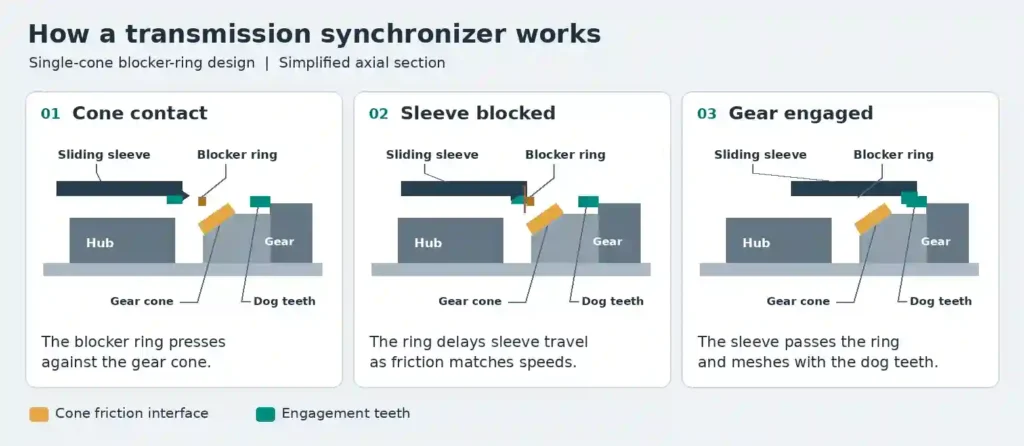
How does a transmission synchronizer work?
In a constant-mesh gearbox, the teeth on third gear already mesh with those of its mating gear. Third gear can still spin freely on the shaft before you select it. The sleeve turns with the shaft, so the gear and sleeve can be rotating at different speeds as the shift begins.
1. The shift fork moves the sleeve toward third gear. The sleeve slides along the splines of a hub fixed to the shaft.
2. The synchronizer ring presses against a cone. In a typical keyed design, the moving sleeve pushes the ring through keys or struts. Friction at the cone turns the ring slightly, putting its blocking teeth in the sleeve’s path. The sleeve pauses while that same friction brings the speeds together.
3. The sleeve engages the dog teeth. Once the speeds match, the sleeve can align the ring and pass its teeth to engage the gear. The gear is now locked to the shaft.
The ring and cone come into contact briefly during the shift to match speeds. Once the sleeve engages the gear’s dog teeth, torque passes through that toothed connection. The example above shows a common ring-and-cone design. Other commercial gearboxes may use different parts to control engagement, but the sequence is the same: match speeds first, then lock the selected gear to the shaft.
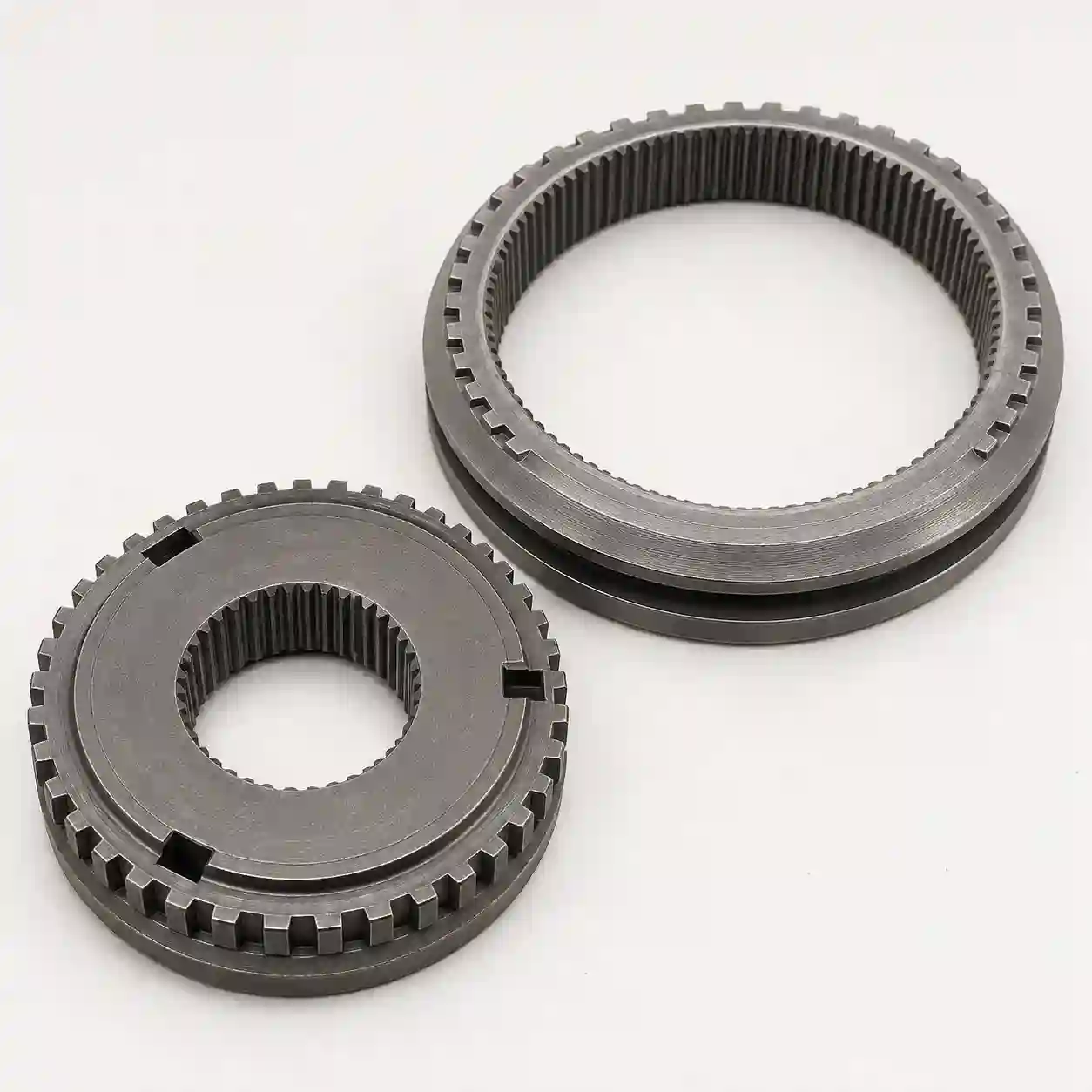
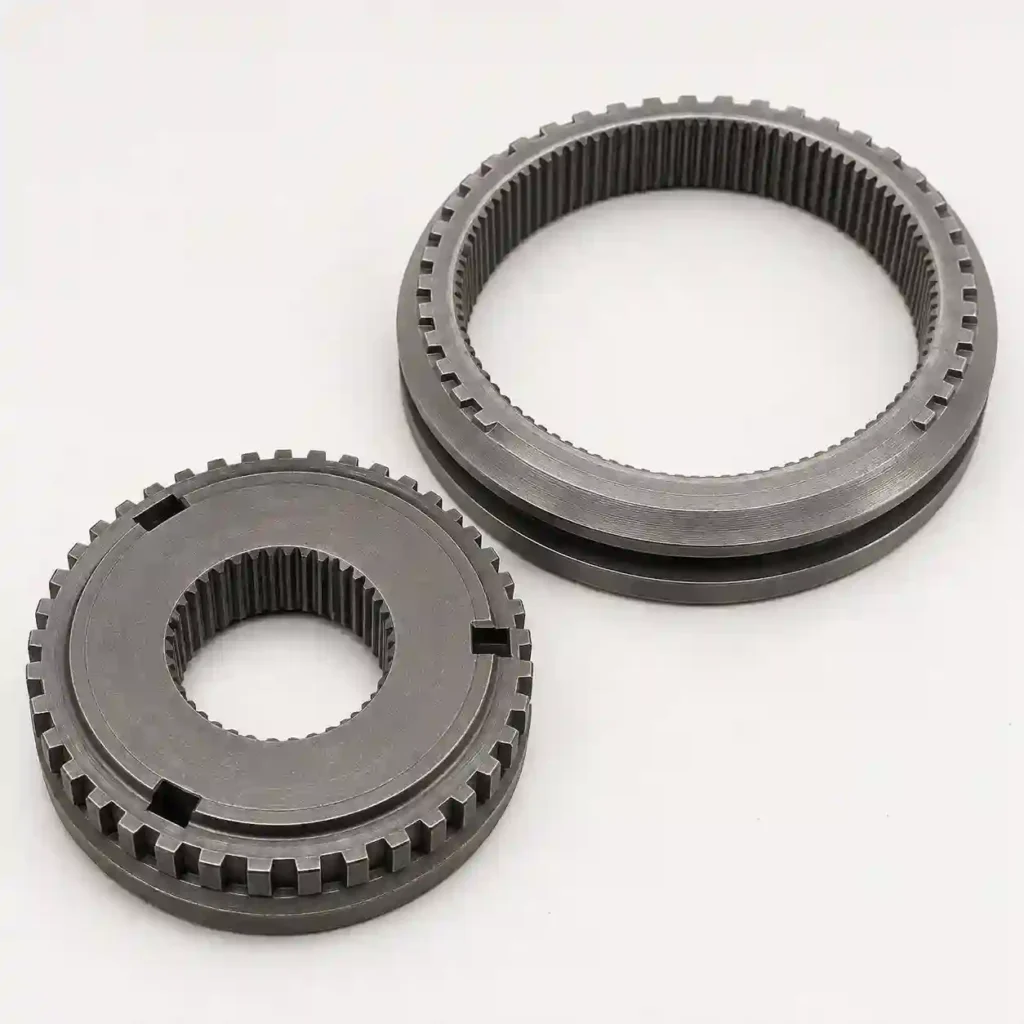
Synchronizer ring, cone, hub and sleeve
In this manual transmission synchronizer, the ring and cone handle speed matching. The synchronizer hub and sleeve form the connection to the shaft once the gear is engaged.
| Part | What it does |
|---|---|
| Synchronizer ring | Also called a blocker ring or baulk ring in this design. Its friction surface works against the cone, and its teeth delay sleeve engagement during speed matching. |
| Synchronizer cone | Provides the tapered surface the ring works against. Depending on the design, that surface may be part of the gear or provided by a separate component. |
| Synchronizer hub | Sits on the shaft splines and turns with the shaft. Its outer splines guide the sleeve. |
| Sliding sleeve | Moves along the hub and engages the selected gear’s dog teeth. The shift fork moves the sleeve through a groove on its outside. |
| Dog teeth | Lock the gear to the shaft through the sleeve once engagement is complete. They are separate from the gear teeth that remain in mesh. |
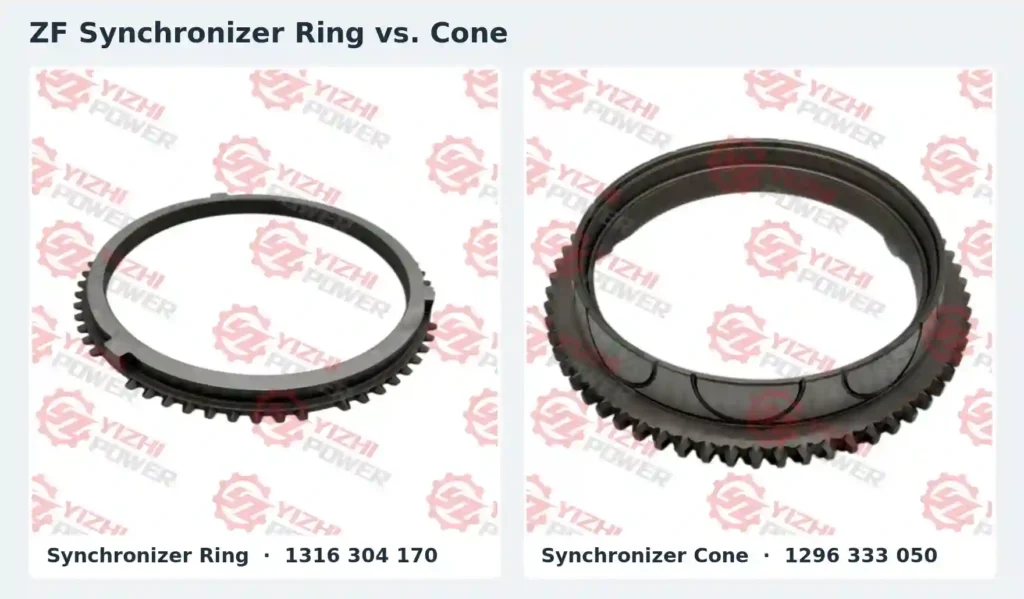
For visual examples, see the ZF synchronizer ring 1316 304 170 ve ZF synchronizer cone 1296 333 050. Each illustrates a different component type. For the wider assembly, the ZF gearbox parts guide shows where components such as the shift fork fit into the transmission.
Worn synchronizer symptoms: grinding and hard shifts
A synchronized shift depends on friction to close the speed gap. If the friction surfaces lose effectiveness, the shift can take longer. The lever may resist entering gear, or the teeth may clash if engagement is attempted before their speeds match.
Pay attention to when it happens. Grinding every time you select third gives you a different starting point from a gearbox that’s stiff across several gears.
| What you notice | What to check |
|---|---|
| The same gear grinds or hesitates on repeated shifts | Inspect that gear’s ring and cone, along with its sleeve and engagement teeth. |
| Several gears are hard to engage | Check clutch release and selector movement as well as the gearbox lubricant. A dragging clutch can keep the input shaft turning. |
| Shifts are noticeably stiffer when cold | Verify the specified lubricant and check whether the behavior improves at operating temperature. For ZF units, refer to the ZF transmission fluid guide to find the relevant lubricant list. |
The pattern helps narrow the inspection. It takes a closer look to tell which part is responsible for the shift problem.
Single-cone vs. multi-cone synchronizers
A single-cone synchronizer uses one pair of tapered friction surfaces to match the gear’s speed to the shaft. Double- and triple-cone designs use additional rings to create two or three friction interfaces. With more surfaces sharing the work, the synchronizer can handle a larger speed difference at a given shift force.
The number of cones describes how the synchronizer matches speeds. The blocking mechanism controls when the gear can engage. Some truck gearboxes use a blocker ring to hold the sleeve back, while others use a split-pin mechanism. Both follow the same sequence: match speeds first, then engage the gear. The main and range sections can use different designs, so check which section you’re looking at when reading a gearbox diagram.
Frequently asked questions
Q1: Is a synchronizer ring the same as a blocker ring?
A1: In a typical baulk-ring synchronizer, both terms refer to the ring that works against the cone and delays engagement while the speeds differ. A synchronizer assembly includes other parts, such as the hub and sleeve.
Q2: What’s the difference between a synchronizer ring and a synchronizer assembly?
A2: The ring is the component that bears against the cone in a baulk-ring design. The assembly includes the parts that work together to synchronize and engage the gear, typically including the hub, sleeve and one or more rings.
Q3: Do all truck transmissions have synchronizers?
A3: No. Truck transmissions include both synchronized and non-synchronized designs. The gearbox model and the particular section determine how the shift is carried out.