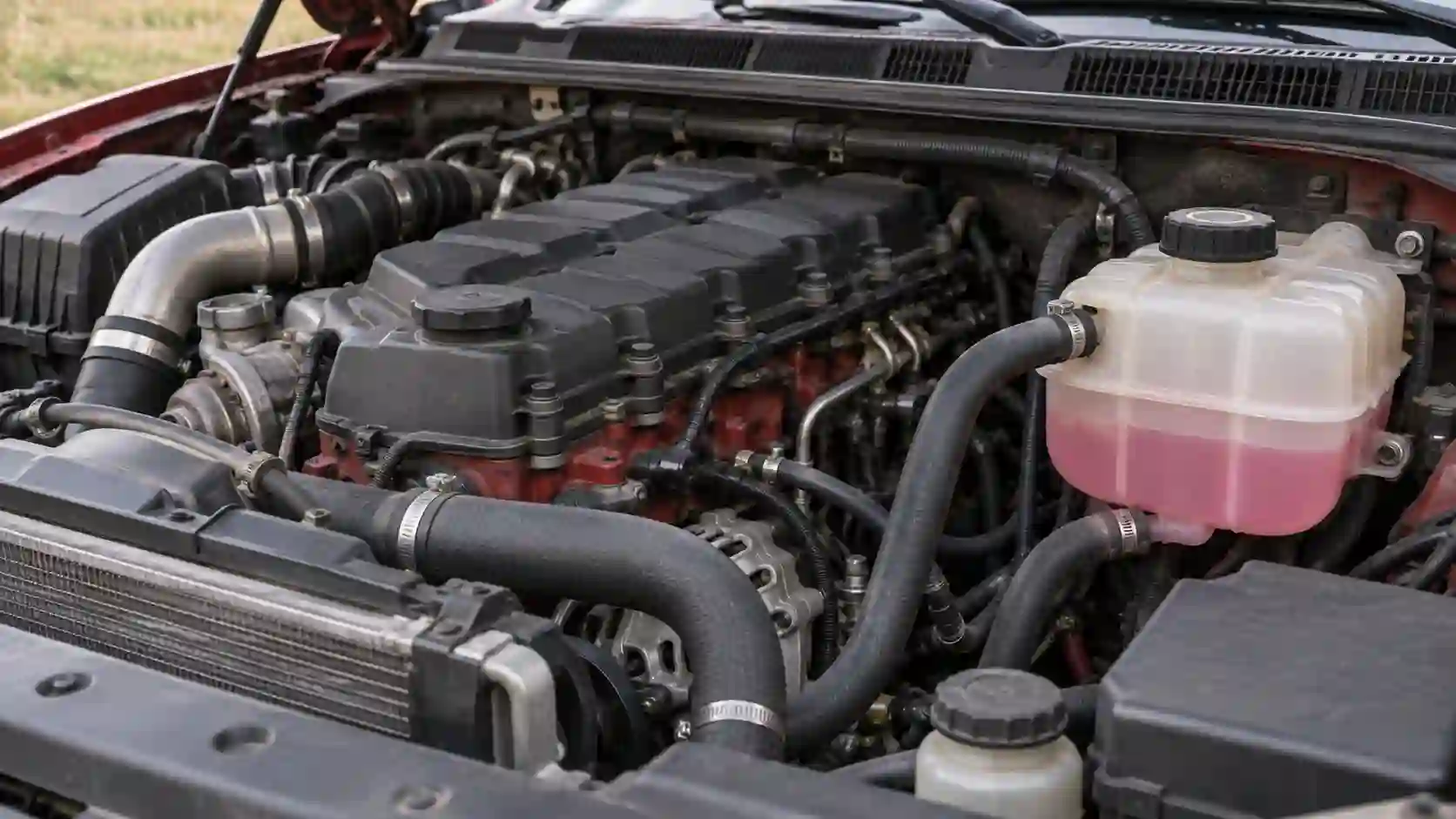
A 6.7 Cummins coolant leak can leave a wet patch under the truck or show up as a falling coolant level. The useful question is where the coolant is escaping. A puddle, stain, or low-level warning alone does not identify the failed part.
This guide focuses on Ram trucks with the 6.7L Cummins diesel. It explains possible leak areas, what different patterns can mean, and why the engine configuration matters. Industrial and other B6.7 applications may use different cooling layouts.
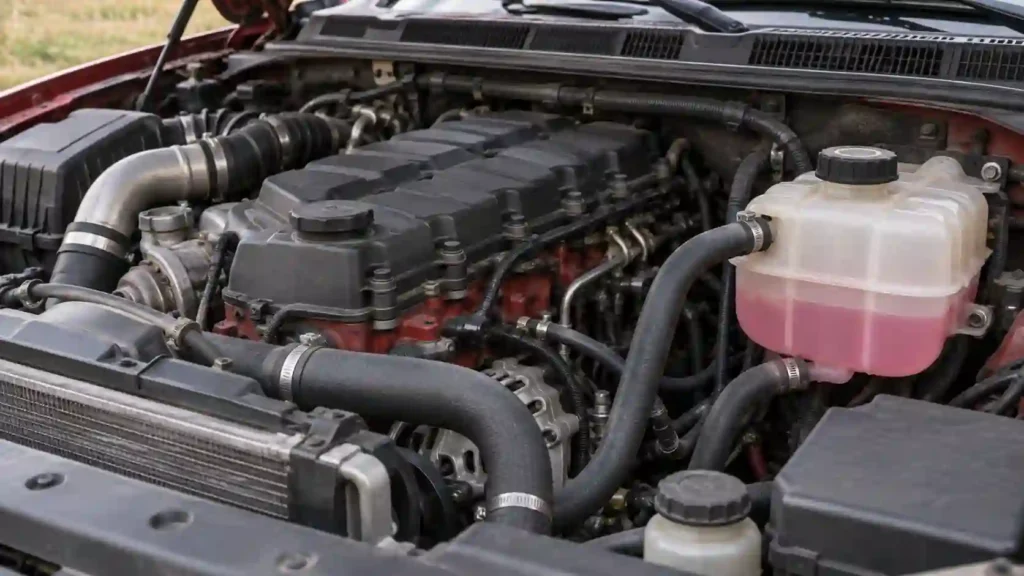
What Can Cause a 6.7 Cummins Coolant Leak?
Possible external leak areas include coolant hoses, joints, the radiator, water pump, and housing seals. However, a list of possible causes is not a ranking of failure rates. The source needs to be confirmed on the individual vehicle.
| Area | What the observation may tell you | What it does not prove |
|---|---|---|
| Hoses and connections | A wet joint can help narrow the search | Whether the hose, clamp, or fitting needs replacement |
| Radiator area | Coolant is present near the front cooling assembly | That the radiator core is the source |
| Water pump area | The pump and nearby connections need closer attention | That every nearby stain comes from the pump |
| Housing joints and seals | Leakage may start at a sealed connection | Which seal or housing version the engine uses |
| Recovery bottle and tubing | The level-control and recovery system needs attention | That the bottle itself has failed |
A broad symptom can involve a small connection or a larger component. That difference matters when a leak report becomes a parts request.
Hoses, Clamps, and Connections
A hose connection has several parts that work together. Replacing the hose may not resolve a sealing problem at another part of the joint.
There is also a useful distinction between coolant leaking near a component and leaking through it. For example, Cummins bulletin TSB200177 describes external leaks at EGR coolant hoses, clamps, or interfaces on specified ISB6.7 and B6.7 configurations. It does not apply automatically to every Ram 6.7.
Water Pump and Housing Seals
The water pump is one possible source of coolant leakage. However, coolant reaching the pump area from elsewhere can make the source less clear. The location of the wet patch should be matched to the actual leak path.
Once the pump has been confirmed as the problem, our คู่มือการเปลี่ยนปั๊มน้ำคัมมินส์ provides broader background. Its examples cover several engine families, so they should not be treated as universal Ram fitment instructions.
6.7 Cummins Coolant Leak on the Passenger Side
A search for a 6.7 Cummins coolant leak on the passenger side describes a location rather than a diagnosis. Coolant may run along nearby surfaces before reaching the ground. As a result, the drip point can differ from the starting point.
The description becomes more useful when it includes a clear reference: the front or rear of the engine, above or below a visible hose joint, and whether the area is wet during operation or after parking.
Avoid turning “passenger-side leak” into an automatic order for an EGR cooler, heater hose, or water pump. First establish which connection or component is losing coolant. Year and chassis details help make that finding meaningful.
6.7 Cummins Coolant Leak with No Visible Puddle
A 6.7 Cummins coolant leak does not always leave a clear puddle. When the level keeps falling, the absence of an obvious external leak is a reason for further investigation. It is not proof of an internal engine failure.
At this point, the difference between a suspected cause and a confirmed cause becomes especially important.
Does Coolant Loss Mean the EGR Cooler Is Bad?
An internal EGR cooler leak is one possibility to assess on an applicable engine. However, coolant loss alone does not justify replacing the cooler.
Stellantis addressed this issue in its December 2022 diagnostic communication S2207000003. It reported that many returned EGR coolers suspected of leaking had no fault found. The communication calls for testing to confirm the leak before replacement.
That is a useful principle for buyers as well as technicians. “The truck is losing coolant” and “the EGR cooler has a confirmed internal leak” are very different purchasing descriptions.
Why Further Testing Matters
The appropriate test depends on the vehicle and suspected leak path. A qualified technician should use the service information for that configuration.
The aim is to establish whether coolant is escaping externally, passing into another system, or being lost through a different route. A parts list should follow that finding. For wider symptoms that occur alongside coolant loss, our Cummins engine troubleshooting guide offers additional context.
6.7 Cummins Coolant Leak: Year and Configuration
Two trucks with 6.7L Cummins engines may not use the same cooling layout or replacement references. Pickup and chassis-cab applications also need to be identified correctly.
Historical service campaigns show why broad model names are not enough. The T51 water pump recall covered certain Ram vehicles, with specific model and production limits. It was not a recall of every 6.7 Cummins engine. Current applicability and completion should be checked by VIN through an official recall service or dealer.
Likewise, an industrial B6.7 bulletin should not be presented as a Ram-specific fault without checking its scope. Engine-family similarity does not establish that a hose, pump, seal, or cooler is interchangeable.
When a 6.7 Cummins Coolant Leak Needs Urgent Attention
Coolant loss combined with overheating, steam, or a stop warning needs prompt attention under the vehicle’s operating instructions. Repeatedly topping up does not explain or resolve the cause.
Do not open a hot or pressurized cooling system. If the engine overheats, follow the vehicle’s safe-stop guidance and allow it to cool before any inspection.
A small recurring loss also deserves attention. Record the cold coolant level under similar conditions and note how often additional coolant is needed. Use the coolant specified for the vehicle; requirements from an older model-year manual should not be applied to every later truck.
From Leak Findings to the Correct Replacement Part
For distributors and importers, a 6.7 Cummins coolant leak enquiry becomes useful once the affected part has been identified. A symptom alone is too broad to establish compatibility.
Useful details include:
- Vehicle year, model, and pickup or chassis-cab application.
- VIN and engine serial number, where available.
- Confirmed leaking component and original part number.
- Clear photos of the part, connections, and label.
- Required quantity.
These details help separate a hose or seal requirement from a pump, housing, or cooler enquiry. They also reduce the chance of comparing parts that look similar but belong to different configurations.
For a confirmed replacement requirement, contact YiZhi Power to discuss supply and application matching. Availability and compatibility need to be confirmed for the specific part.
สรุป
A 6.7 Cummins coolant leak is best understood by combining the leak location, operating pattern, and exact vehicle configuration. Start with evidence of where coolant is escaping, rather than assuming that one familiar component must be responsible.
That approach makes the article’s main distinction practical: finding coolant near a part is not the same as confirming that part has failed. A clear finding supports a more accurate replacement decision.
คำถามที่พบบ่อย
Q1: What causes a 6.7 Cummins coolant leak?
A1: Possible sources include hoses, connections, the radiator, water pump, and sealed joints. Continued coolant loss without an obvious external source needs further assessment. The symptom alone does not identify a failed component.
Q2: What causes a passenger-side coolant leak on a 6.7 Cummins?
A2: The side of the truck is not enough to identify the cause. Coolant can travel before dripping. The actual leak path and vehicle configuration need to be established.
Q3: Can a 6.7 Cummins lose coolant without a visible puddle?
A3: Yes. No obvious puddle does not rule out coolant loss. Persistent loss needs further investigation, including assessment of possible internal leaks where appropriate.
Q4: Should I replace the EGR cooler if the coolant level keeps falling?
A4: Not on that evidence alone. Confirm the leak before ordering a cooler. Manufacturer guidance specifically warns against replacing suspected coolers without testing.
Q5: Does every 6.7 Cummins use the same cooling-system parts?
A5: No. Vehicle year, application, engine configuration, and part reference matter. A broad engine-family description is not enough to confirm fitment.
- WhatsApp: +86 186 7197 8898
- อีเมล: info@yzdlparts.com
- เว็บ: www.yzdlparts.com